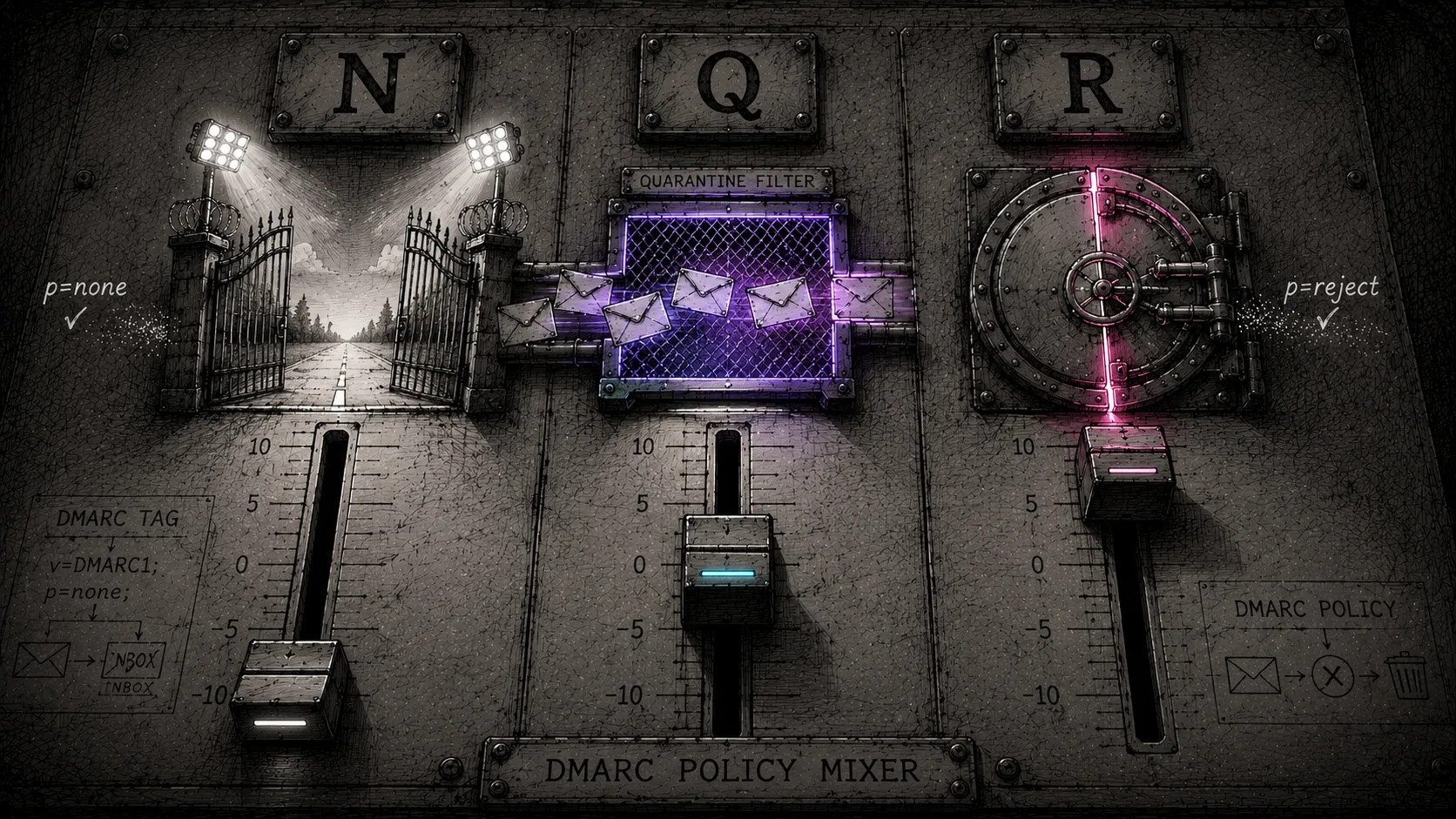
DMARC Policy: None vs Quarantine vs Reject
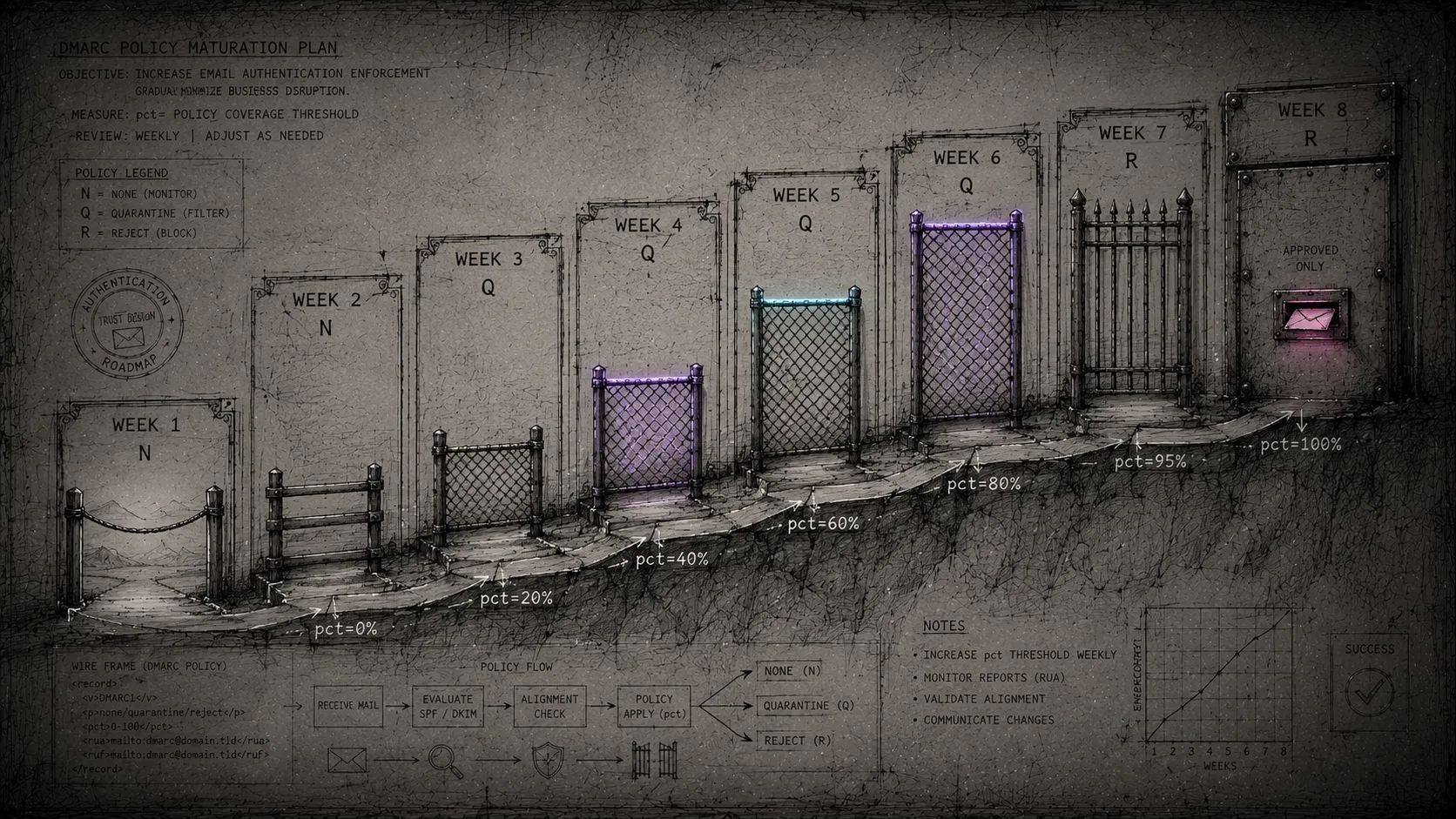
Choosing a DMARC policy is not a one-time DNS edit. None monitors, quarantine filters, reject blocks unauthenticated mail. Rollout order, pct= staging, and provider-specific pitfalls for 2026.
Comparison
SecurityScorecard rates how your organization looks from the outside — vendor risk scores, attack-surface grades, and board-ready dashboards. ZeroHook proves your email and DNS controls work — with continuous monitoring, copy-paste fixes, and auditor-ready evidence at SMB pricing.
Best for EU SMBs under NIS2, SaaS companies pursuing SOC2, and compliance leads who need DNS-specific evidence — not a full enterprise security ratings platform costing five figures annually.
SecurityScorecard pioneered security ratings for vendor risk management. Enterprise security teams use it to score suppliers, track remediation SLAs, and report aggregate risk to the board. Typical contracts run around $26,000/year for mid-market coverage — justified when you manage hundreds of third-party relationships.
NIS2, SOC2 CC6.6, and ISO 27001 Annex A audits ask a narrower question about email infrastructure: can you prove SPF, DKIM, and DMARC were correctly configured and monitored over time? A letter grade on your external attack surface does not export the DMARC aggregate reports, DNS change history, or remediation tickets an auditor requests.
ZeroHook Evidence ($199/mo, $1,910/yr) automates that evidence collection: 50 monitored domains, 365-day tamper-proof audit logs, compliance PDF generators, Excel exports, and auditor portal access. Deliverability ($29/mo) covers teams that need monitoring and fixes without the full evidence pack. The 82% savings vs SecurityScorecard benchmarks come from scope — DNS and email authentication, not full attack-surface ratings.
Choose ZeroHook when compliance questions center on email transmission security, DNS controls, or deliverability — the areas NIS2 Article 21 and SOC2 CC6.6 actually test.
EU SMBs in essential and important sectors need documented technical measures for network and information systems. ZeroHook maps 35 checks to NIS2, ISO 27001, and SOC2 controls, exports auditor PDFs, and maintains hash-verified monitoring history your assessor can verify independently.
Manual audit prep for transmission security often costs $15,000–$30,000 in consultant hours. ZeroHook continuous monitoring produces the ongoing proof CC6.6 expects — at $2,388/year on Evidence tier vs five-figure ratings platforms.
SecurityScorecard tells you something is wrong with your external footprint. ZeroHook outputs the exact DNS TXT and CNAME records to fix SPF permerrors, DMARC misalignment, and missing MTA-STS — then re-scans to confirm the remediation held.
External auditors often need read-only access without a sales call. ZeroHook Evidence includes auditor portal access, Excel compliance export, and branded PDF reports — purpose-built for assessment workflows, not vendor risk dashboards.
SecurityScorecard fits enterprise vendor-risk programs that extend well beyond email DNS.
If your core job is scoring hundreds of suppliers, tracking their remediation SLAs, and feeding data into a GRC platform, SecurityScorecard’s ratings network and ecosystem integrations are purpose-built for that — ZeroHook does not replace a VRM program.
CISOs reporting portfolio-wide risk scores to the board need aggregate ratings, benchmarking, and trend lines across domains, IPs, and cloud assets. That is SecurityScorecard’s wheelhouse; ZeroHook is intentionally scoped to DNS and email authentication.
Large organizations with ServiceNow, Archer, or similar GRC workflows may already have SecurityScorecard in their stack. ZeroHook can complement that stack for DNS-specific evidence without rip-and-replace.
SecurityScorecard pricing scales with company size and module selection. ZeroHook Evidence at $1,910/yr targets the same compliance buyer with DNS-focused monitoring — roughly 82% below published SecurityScorecard benchmarks for comparable SMB use cases.
Evidence $199/mo ($1,910/yr) · Deliverability $29/mo
~$26,000/yr (typical enterprise contract; quote-based)
Fact-based comparison from public product positioning. Verify competitor details on their site before purchase decisions.
| Feature | ZeroHook | SecurityScorecard |
|---|---|---|
| Primary focus | Email authentication, DNS security, compliance evidence | Third-party security ratings and vendor risk management |
| NIS2 / SOC2 evidence | Automated evidence collection, hash-verified audit log, PDF reports | Security scorecards and risk metrics; not DNS record evidence |
| Copy-paste DNS fixes | Yes — actionable SPF/DKIM/DMARC fixes per DNS provider | No — ratings and recommendations, not DNS remediation |
| Continuous DNS monitoring | Yes — SPF/DKIM/DMARC/MTA-STS change detection | External attack surface scanning; different signal set |
| Typical buyer | SMB IT, compliance leads, MSPs (10–500 domains) | Enterprise security and GRC teams |
| Auditor portal | Yes — read-only access for external auditors | Vendor risk dashboards; not DNS audit evidence |
| Annual cost (benchmark) | $1,910/yr (Evidence tier) | ~$26,000/yr (public benchmark) |
Identify which compliance frameworks your next audit covers — if email/DNS transmission security is in scope, list every sending domain (corporate, marketing, transactional, subdomains).
Run ZeroHook free scan on each domain; document baseline health scores and top failures before your audit window opens.
Enable Evidence tier 60+ days before audit if possible — auditors prefer monitoring history over point-in-time screenshots.
Grant auditor portal access when the assessor requests evidence; export Excel and PDF packs mapped to NIS2 Article 21 or SOC2 CC6.6 as needed.
For NIS2 Article 21 email and transmission security evidence, ZeroHook provides continuous DNS monitoring, tamper-proof logs, and exportable reports auditors expect. SecurityScorecard addresses broader vendor risk — many enterprises use both, but SMBs often only need DNS-focused evidence.
ZeroHook scopes to email authentication and DNS security rather than full attack-surface ratings. That focus keeps pricing accessible for SMBs while delivering the specific evidence NIS2 and SOC2 CC6.6 audits require for mail infrastructure.
ZeroHook provides a health score per domain based on 35 audit checks, plus compliance framework mapping. It is not a third-party vendor rating like SecurityScorecard’s letter grades.
Choose Evidence ($199/mo) for NIS2 or SOC2 workflows: 50 domains, 365-day tamper-proof logs, auditor PDFs, and Excel export. Deliverability ($29/mo) suits teams focused on inbox placement without full evidence packs.
Yes. The Evidence tier includes auditor portal access so external assessors can review monitoring history without a full account.
Keep it for vendor risk if that program is established. Add ZeroHook Evidence for the DNS and email slice your ratings tool does not export — many teams run both until the next contract renewal, then reassess overlap.

Choosing a DMARC policy is not a one-time DNS edit. None monitors, quarantine filters, reject blocks unauthenticated mail. Rollout order, pct= staging, and provider-specific pitfalls for 2026.

Move from monitor-only DMARC to p=reject in eight weeks using aggregate reports, pct= staging, and sender inventory. Standard path for SMBs on M365, Google Workspace, and ESP relay mail.

When DMARC alignment fails but SPF passes, your envelope-from or DKIM domain does not match the visible sender. Quick diagnosis from Authentication-Results and ESP fix steps.